Merlijn - 18 / Sep / 2026
Fluoride, hydroxyapatite or maybe both: what fits you best?
Fluoride, hydroxyapatite or maybe both? If you go looking for a sustainable toothpaste, you'll quickly come across these ingredients on packaging and in commercials. One has been offered and recommended for decades, while the other is presented as the trendy, natural alternative. But what do these ingredients actually do to your teeth? And which one suits you and your family best?

What does fluoride actually do in your toothpaste?
There's some debate about how fluoride works. Generally, it's added to toothpaste to 'remineralise' your teeth. That means the mineral makeup of fluoride (fluorite) helps repair your tooth enamel and so prevents future cavities. Bacteria in your mouth turn sugars into acids, which slowly dissolve your enamel. A toothpaste with fluoride builds these minerals back up.
A fun fact for the dinner table: in the past we didn't need fluoride, because the substances in saliva also partly carry out that repairing task. But because the average diet now contains far more sugars and acidic drinks than before, our enamel could use a little extra help.
Take a look at the full range of toothpaste and oral care from Grace here.
Is fluoride harmful?
Fluoride in normal doses in your toothpaste isn't harmful to your health. In recent years, more and more theories have been circulating online and on social media claiming that fluoride is harmful. This is only true if you ingest a much higher dose than what's normally in your toothpaste. In the Netherlands there's also no fluoride in tap water, so your total intake is already lower than the average in some other countries.

And what is hydroxyapatite, a 'natural' alternative?
Hydroxyapatite, like fluoride, is a natural mineral. It occurs in your body, for example in your tooth enamel and bones. Hydroxyapatite toothpaste contains hydroxyapatite as its active ingredient. It strengthens tooth enamel in a natural way by attaching itself to the tooth surface and, just like fluoride, repairing damage to the enamel.
The fact that hydroxyapatite already occurs so abundantly in your teeth makes it a mild and very safe option. That's why it can be used not only by adults with regular teeth, but also by people with sensitive teeth and by children.
Fluoride, hydroxyapatite, or both?
So then the big question: which do you choose? The good news is that you really can't go wrong. Both minerals essentially do the same thing: they remineralise your enamel and so protect against cavities. The biggest difference is that hydroxyapatite is a lot newer. Fluoride has been recommended for decades, while hydroxyapatite has been in use for a relatively short time.
Looking at it scientifically, fluoride and hydroxyapatite don't work better or worse, but mainly differently. Fluoride stimulates your saliva and uses components from it to build a stronger form of enamel. Hydroxyapatite works more directly, because it replenishes the enamel itself and repairs damage.
In practice they end up remarkably close together. Various studies and review articles conclude that hydroxyapatite is equivalent to fluoride when it comes to remineralising early enamel damage. Only for young children can hydroxyapatite be a little more attractive, because swallowing it is harmless. But here too: swallowing fluoride is only dangerous in large amounts. So there's no real difference there.

Which one suits you (and your child)?
Now you know that both minerals take excellent care of your teeth. So the main thing is that your toothpaste contains at least one of them. Do you prefer to brush your little one's teeth fluoride-free, for whatever reason? Then hydroxyapatite is a good alternative. The mineral toothpaste from Georganics is a trusted choice, now with a lovely strawberry flavour.
On top of that, toothpaste has long since stopped being just a gel in a plastic tube. In the sustainable range you'll come across about three forms: the familiar paste, but in a glass jar, the toothpaste tablets, and toothpaste in powder form. Each form has its own advantages, with sustainability playing an especially important role.
See all available forms of oral care here.
Do the flavour and form still matter?
For protecting your teeth, flavour and form don't matter. It's simply a question of your personal preference. Flavour can be an appealing factor in keeping up regular brushing. Especially with children this plays a bigger role than you'd think: the younger the children, the more quickly a familiar flavour helps in building a routine of oral care.
The form mainly affects your ease of use and your waste pile. The toothpaste tablets from Georganics, for example, are ideal for on the go and always measure out the dose perfectly. And do you want to round off your routine completely? Then mouthwash can be a nice addition. See all the mouthwashes from Georganics and Niyok here.
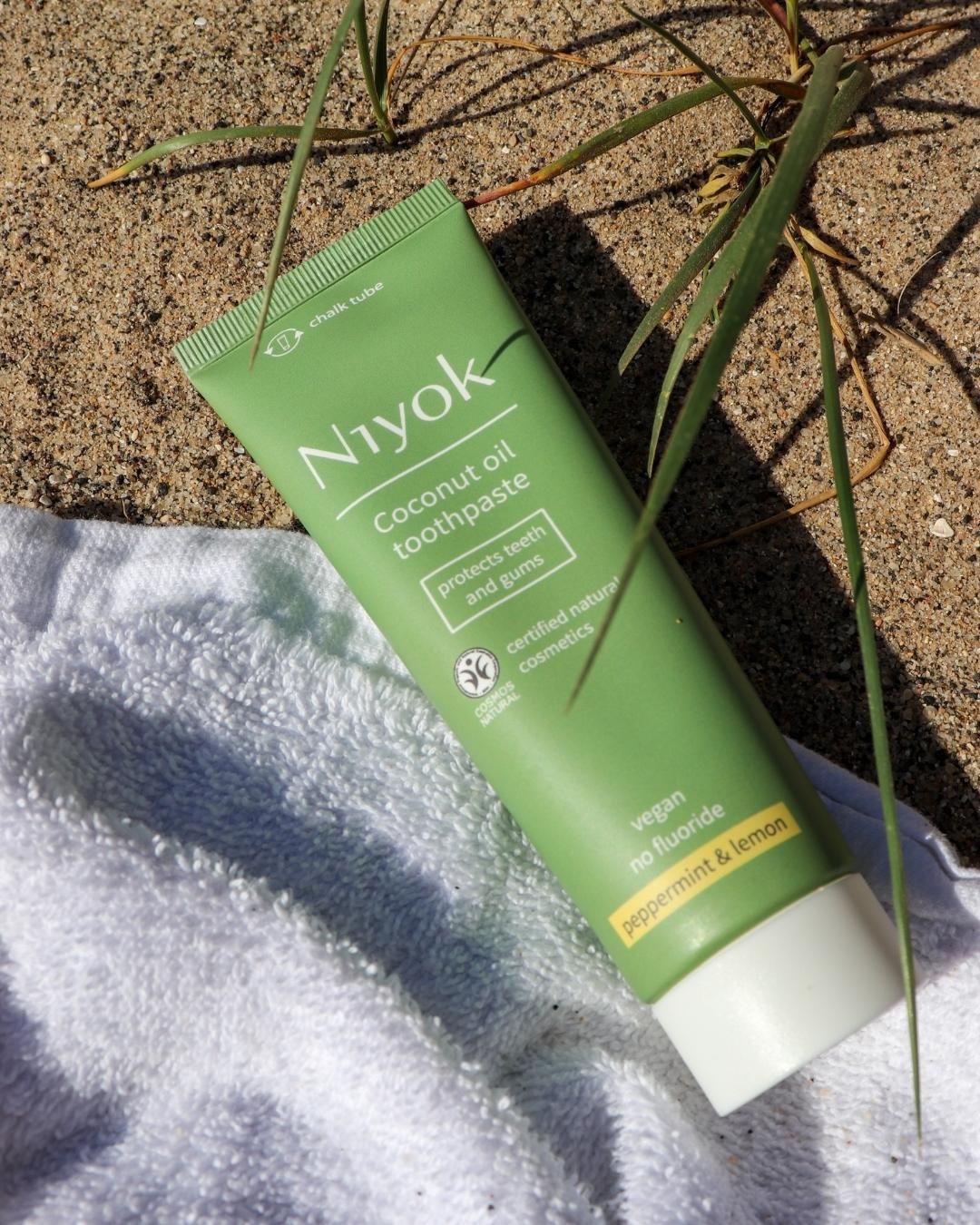
How to get the most out of your toothpaste
Perhaps even more important than the choice between fluoride and hydroxyapatite is the way you brush. A good brushing routine undeniably improves your oral hygiene. Want to let your repairing mineral work optimally, for instance? Then don't rinse your mouth out with lots of water, because that washes the active ingredient straight back out.
Brush twice a day for about two to three minutes. Don't use too much or too little toothpaste. The rule of thumb here is roughly a pea-sized amount for adults. Up to about age 3 this is a grain of rice; then from 3 to 6 years a pea-sized amount of children's toothpaste (which contains less fluoride).
Make your choice between fluoride, hydroxyapatite or both at Grace is Green
Sources: Journal of Dentistry, American Dental Association, BDJ Open, Frontiers in Public Health, KRO-NCRV